Embedded Systems · Avionics
L1 Flight Computer
1 / 4
Overview
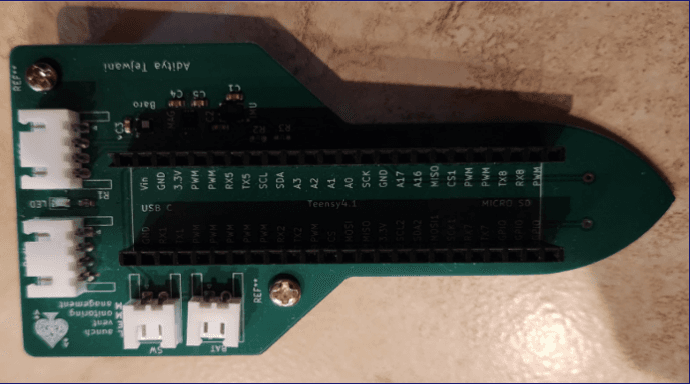
I built a custom flight computer designed for a Level 1 high-power rocket. It measures altitude, orientation, and pose throughout the rocket's flight. It is composed of a microcontroller, an IMU (Inertial Measurement Unit), a barometer, and a magnetometer, along with external GPS and radio telemetry connections.
All of the sensors operate on 3.3V logic. I optimized the components for compact size and low mass, altitude and orientation measurement, and resilience to high acceleration and vibration.
Design Approach
Each component was chosen to meet the goals above, with everything running on 3.3V logic.
Microcontroller: Teensy 4.1
- —High clock speed (600 MHz)
- —Enough processing power to interface with the sensors, GPS, and radio over multiple UART and I2C buses
- —Able to store collected data on its onboard SD card
Barometer: LPS22HH
- —High absolute accuracy (about 0.5 hPa)
- —Wide pressure range (260-1260 hPa)
- —I2C interface
IMU: LSM6DSO
- —Wide measurement range: ±16 g for the accelerometer and ±2000 degrees/sec for the gyroscope
- —I2C interface
Why a 6-axis IMU and not a 9-axis one? A 9-axis IMU includes a magnetometer, but I chose to use a separate MLX90397RLQ-AAA-000-SP magnetometer, which experiences less magnetic interference than an integrated one. The LSM6DSO is also smaller and cheaper than most IMU bundles.
Magnetometer: MLX90397RLQ-AAA-000-SP
- —16-bit resolution, so it can detect smaller variations in magnetic field direction or strength
- —High sensitivity
- —I2C interface
Simulation & Testing
ADD: how you verified that it works, such as bench tests, sensor calibration, comparison against a reference, or data logged on a flight. Only include what you actually did.
Key Features
In typical conditions, the flight computer can measure:
- —Altitude: up to 10-11 km
- —Orientation: pitch, yaw, and roll within 5-10 degrees of error
- —Angular velocity: up to 2000 degrees per second
- —Linear acceleration: up to 16 g
- —Onboard SD card data logging
- —External GPS and radio telemetry connections
- Embedded Systems
- Teensy 4.1
- I2C
- UART
- IMU
- GPS/GNSS
- KiCAD