RF · Electronics
RF Filter Designer
1 / 4
Overview
This project is a desktop application for designing LC ladder filters used in RF circuits. It was built to simplify the process of going from theoretical filter specifications to practical, simulation-ready designs.
RF filters are essential in wireless systems to control bandwidth and suppress unwanted harmonics. Designing them by hand is time-consuming and error-prone, especially when accounting for real-world component constraints. The application automates the full design pipeline, from mathematical synthesis to component selection to simulation-ready output.
The goal was to bridge the gap between theoretical filter design and practical hardware implementation.
Design Approach
The application follows standard RF filter synthesis techniques. First, normalized prototype values (g-values) are selected based on the desired response type, such as Butterworth or Chebyshev. These values define the ideal filter shape.
Next, the normalized values are scaled using the target cutoff frequency and system impedance to compute real inductor and capacitor values. Since ideal values are not physically available, all components are snapped to the nearest E24 standard series values so the design can be built with real components.
Simulation & Testing
To evaluate performance, the filter is modeled using ABCD transmission matrices, which lets the application compute the frequency response of the ladder network. It then calculates the S21 parameter (gain) and plots it in decibels across frequency, with a -3 dB reference line to show the cutoff point.
This gives immediate feedback on how the rounded, real component values affect performance.
Key Features
- —Low-pass, high-pass, and band-pass filter designs
- —Selectable response types (such as Butterworth and Chebyshev) and orders from 1 to 9
- —Both ideal and realizable (E24-snapped) component values
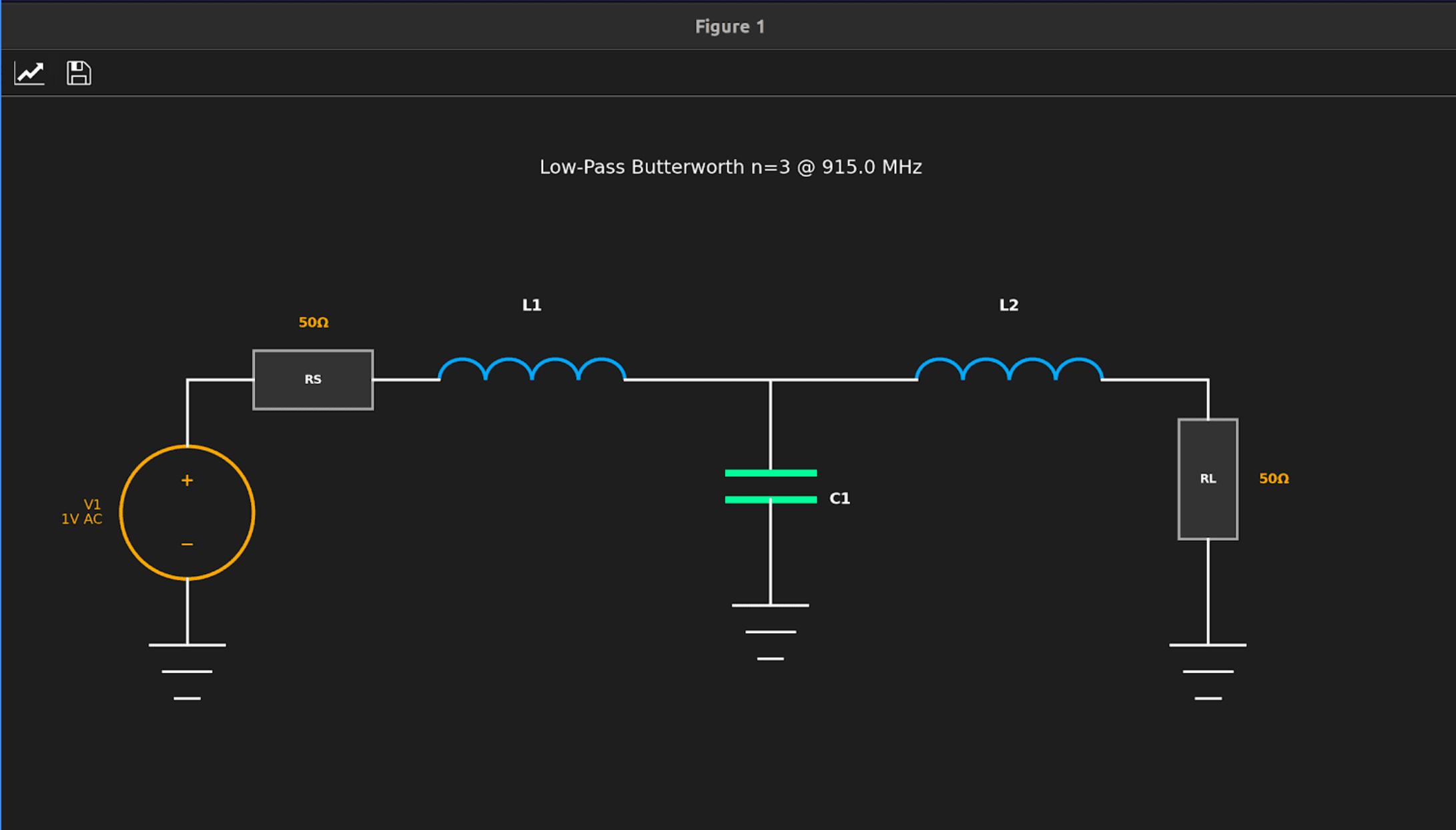
- —A visual ladder schematic of the network
- —S21 frequency response plot in dB with a -3 dB reference line
- —LTspice-compatible netlist export for further validation
- RF Filter Design
- LC Ladder Filters
- Butterworth
- Chebyshev
- ABCD Matrices
- S-Parameters
- LTspice
- E24 Component Selection