Computer Vision · Marine Robotics
Semantic Segmentation of Underwater Images
Overview
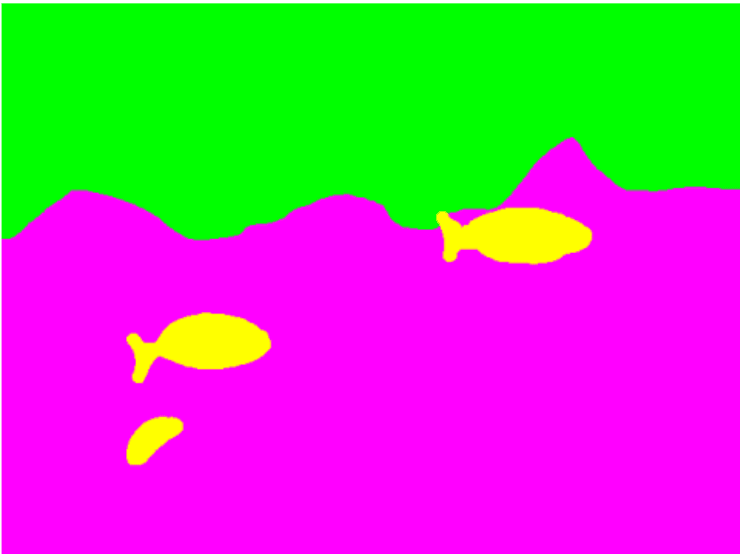
Semantic segmentation is a computer vision method that assigns a class label to every pixel in an image. In marine robotics, this lets a robot understand its surroundings by recognizing marine life, seabed features, and man-made structures.
Underwater image processing is challenging because of light scattering, low contrast, and color distortion. This project applies a U-Net-based segmentation model with attention layers to improve the pixel-wise classification of images from the SUIM (Semantic Segmentation of Underwater Imagery) dataset.
The code repository is currently private. If you would like to see it, send me an email at autejwani@gmail.com.
Design Approach
Dataset and Preprocessing
- —SUIM dataset, which provides pixel-level annotations for 10 class labels (IDs 0 to 9, including background)
- —Images and masks resized to 320×240 pixels
- —Pixel values scaled to the range [0, 1]
- —RGB masks converted to pixel-wise class indices
- —Random horizontal flips with a 50% chance as data augmentation
Classes
- —0: Background (black)
- —1: Human divers (blue)
- —2: Aquatic plants (green)
- —3: Wrecks/ruins (gray)
- —4: Robots/ROVs (cyan)
- —5: Fish (yellow)
- —6: Crustaceans (red)
- —7: Mollusks (magenta)
- —8: Coral (orange)
- —9: Other animals (white)
The colors are the mask colors used for each class.
Model Architecture
- —U-Net encoder-decoder with attention blocks, to improve focus on important features in very noisy images
- —ConvBlock: Conv2d, BatchNorm, and ReLU, repeated twice for deep feature extraction
- —MaxPooling reduces the spatial dimensions of the feature maps in the encoder
- —Attention blocks let the decoder focus on important encoder features by suppressing irrelevant background regions
- —ConvTranspose2d layers upsample the feature maps in the decoder, where they are combined with encoder features to reconstruct the segmentation map
- —One final convolution layer produces the segmentation output
- —95 layers in total: 34 in the encoder, 32 in the attention blocks, 28 in the decoder, and 1 output layer
Loss Function and Metrics
- —Cross-entropy loss: the model outputs per-pixel class scores (logits), and the loss applies softmax and penalizes incorrect class probabilities during training
- —Pixel accuracy: the fraction of correctly classified pixels
- —Dice coefficient: measures the overlap between predicted and true masks, and is less sensitive to class imbalance than pixel accuracy. Dice = (2 × intersection + smooth) / (prediction sum + label sum + smooth), where smooth is a small constant that avoids dividing by zero
- —Intersection over Union (IoU): the overlap ratio between the predicted and ground-truth regions. IoU = (intersection + smooth) / (union + smooth), where union is the total number of pixels predicted or labeled as the class
Simulation & Testing
Training Setup
- —Batch size of 4 and 120 epochs
- —Adam optimizer with a learning rate of 1e-4
- —Cross-entropy loss, suited to multi-class segmentation
- —Data loader with 2 worker processes and shuffling enabled
- —Trained on a GPU when available, and on the CPU otherwise
- —Best model weights saved whenever the average training loss improves
- —Each epoch: forward pass, loss computation, backpropagation, then pixel accuracy, Dice, and IoU calculation, with running loss and accuracy displayed during training
Results
- —Loss decreased from about 0.75 to about 0.10 over the course of training
- —Pixel accuracy increased from about 30% to about 93%
- —Dice score increased in step with pixel accuracy
- —IoU grew continuously throughout training
The Dice score is reported as 1 minus the Dice loss.
Future Work
- —Train with a combined Dice loss and cross-entropy loss
- —Experiment with different preprocessing and augmentation strategies
Key Features
- —U-Net architecture with attention blocks, designed for noisy underwater images
- —Trained on the SUIM underwater segmentation dataset
- —Evaluated with pixel accuracy, Dice coefficient, and IoU
- —Best-model checkpointing during training
- —Planned improvement: a combined Dice and cross-entropy loss
- Semantic Segmentation
- U-Net
- Attention Mechanisms
- Computer Vision
- Deep Learning
- PyTorch
- Marine Robotics